

Why ERP-Led Businesses Struggle Online: The Top 10 eCommerce Challenges Revealed
Table of Contents
- 1. A Significant Portion of Businesses Still Have No eCommerce Presence
- 2. Manual Data Entry Overwhelms Teams and Increases Costs
- 3. Real-Time Inventory and Order Visibility Is Difficult Without ERP-Driven Syncing
- 4. Standalone Websites Create Information Silos That Hurt Accuracy
- 5. Partial Integrations Provide Limited Relief but Still Create Gaps
- 6. Integration Complexity and Cost Deter Digital Progress
- 7. Maintaining Accurate Product and Pricing Data Is a Constant Struggle
- 8. Delivering a Modern Customer Experience Requires ERP-Specific Precision
- 9. Disconnected Systems Create Internal Bottlenecks Across Departments
- 10. Digital Infrastructure Limits Scalability and Growth
- Final Thoughts: Aligning ERP and eCommerce Is the Path Forward
For companies that run on a Sage X3, 300, Intacct or Microsoft Dynamics 365 Business Central ERP, going online introduces eCommerce challenges that most retailers never face. Contract pricing, detailed product data, customer-specific rules, and live inventory all live inside the ERP, not in the webstore. If those elements don’t sync perfectly, the result is predictable: incorrect orders, frustrated buyers, and teams stuck manually reconciling systems that were never meant to operate separately.
This disconnect isn’t theoretical, it’s something ERP-led businesses are actively struggling with. That’s why, during a recent webinar we hosted with Sage, we asked attendees two questions:
What does your current eCommerce setup look like?
and
What is your biggest challenge with eCommerce today?
The results exposed clear patterns.
What Does Your Current eCommerce Setup Look Like?
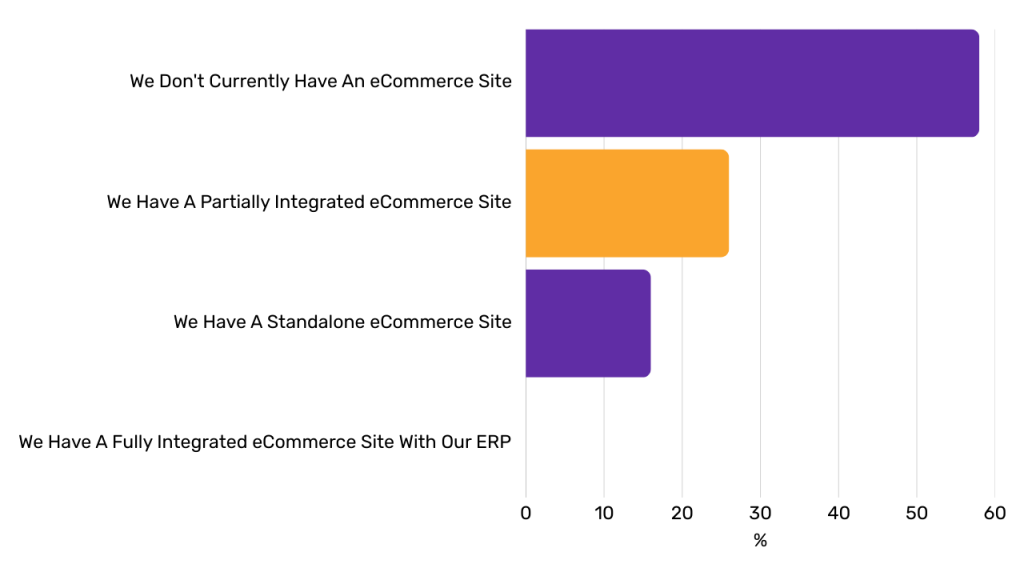
• 58% do not have an eCommerce site at all, showing how many ERP-led organizations are still struggling to take the first digital step.
• Only 16% use a standalone site, which often introduces data silos and duplicate work, and 26% use a partially integrated one, meaning most still rely heavily on manual processes.
• 0% reported having a fully integrated ERP-connected eCommerce site, highlighting how challenging it is to connect ERP logic to traditional eCommerce platforms.
What Is Your Biggest Challenge With eCommerce Today?
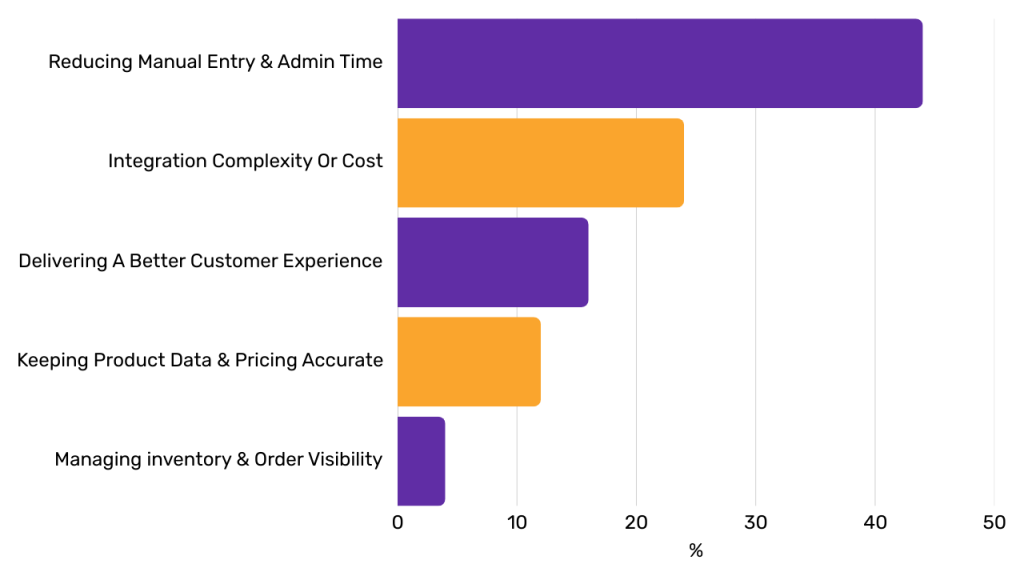
As for challenges, respondents identified:
• 44% – reducing manual entry and admin work
• 24% – integration complexity or cost
• 16% – improving customer experience
• 12% – maintaining accurate data and pricing
• 4% – managing inventory and order visibility
Combined, these results offer a clear picture: ERP-run organizations face unique constraints when bringing their business online. Below are the top 10 challenges, explained in depth, that both B2B and B2C companies encounter when their digital systems do not align with their ERP.
1. A Significant Portion of Businesses Still Have No eCommerce Presence
That 58% of respondents have no eCommerce site reinforces how challenging digital adoption can be for ERP-centric organizations. Unlike standard retail businesses, ERP-run operations must replicate complex back-end logic, such as contract pricing, discount structures, tax rules, warehouse allocations, and fulfillment workflows, all of which are difficult to recreate in traditional eCommerce systems. Standard eCommerce platforms typically do not replicate these intricacies well, which leaves businesses fearing costly customizations or operational disruptions.
For both B2B and B2C, not having an online channel limits growth. B2B customers increasingly expect self-service ordering and account visibility, while B2C customers expect to transact instantly. Without eCommerce, businesses are forced to rely heavily on phone orders, email requests, and sales reps, all of which slow down scaling efforts.
2. Manual Data Entry Overwhelms Teams and Increases Costs
For both B2B and B2C operations, manual entry has a compounding effect on workload and accuracy. When orders placed online do not flow directly into the ERP, someone must re-key them, sometimes hundreds per day. This is particularly painful for B2B organizations where orders often include multiple line items, negotiated pricing, and customer-specific terms. Every manual touch introduces the possibility of errors, which leads to returns, credits, and customer frustration. Because ERP-run companies manage more complex orders, pricing rules, and customer-specific terms, manual entry becomes exponentially harder compared with simpler retail environments.
Even for B2C businesses, manual work creates hidden costs: slower order processing, delayed fulfillment, and the inability to scale order volume without hiring more administrative staff. With 44% of webinar respondents highlighting manual entry as a major challenge, it’s clear that incomplete data flow is one of the biggest barriers to digital growth.
3. Real-Time Inventory and Order Visibility Is Difficult Without ERP-Driven Syncing
Visibility is essential for both sides of commerce. B2C buyers expect accurate stock counts to avoid placing orders for items that are unavailable. B2B buyers rely on precise stock levels to forecast purchasing, plan replenishments, and manage downstream commitments to their own customers. But 4% of respondents indicated they struggle with inventory and order visibility, a predictable outcome when eCommerce platforms rely on batch updates or outdated snapshots of ERP data.
When systems don’t sync in real time, businesses risk overselling, disappointing customers, and disrupting operations. This not only leads to operational confusion, but also affects cash flow as orders are delayed or require manual intervention. Fulfillment teams end up scrambling to reconcile online orders with actual availability, while customer service becomes overloaded with inquiries such as “Where is my order?” or “Why does your website say something different from your sales team?”
4. Standalone Websites Create Information Silos That Hurt Accuracy
The 16% of respondents using standalone sites often encounter the same issue: the eCommerce platform becomes a separate island of information. Product catalogs must be updated twice. Pricing must be managed twice. Customers see information that may not match what the ERP contains. For B2B businesses with hundreds or thousands of SKUs, or with customer-specific pricing contracts, maintaining accuracy across systems becomes nearly impossible.
In B2C environments, silos can lead to mismatched inventory, incorrect promotions, and negative brand experiences. Customers expect online and operational systems to reflect the same truth, but standalone solutions make that difficult. Over time, these inconsistencies erode customer trust and force internal teams to rely on manual corrections just to keep basic operations aligned.
5. Partial Integrations Provide Limited Relief but Still Create Gaps
26% of webinar participants operate with partially integrated eCommerce. In many cases, this setup relies on third-party connectors to move select pieces of data, often just basic inventory levels or simple pricing, between the webstore and the ERP. While connectors can be helpful, they are rarely built to support the full depth of ERP logic needed in B2B and B2C environments. B2B businesses, in particular, depend on advanced capabilities like contract pricing, customer-specific catalogs and multi-location inventory. When connectors only synchronize surface-level data, all of that complexity is left behind, forcing teams to manually reconcile gaps.
This fragmented approach creates both operational and financial challenges. Connectors often require ongoing maintenance, updates, and subscriptions – costs that compound the more customization a business needs. When a connector breaks or fails to sync properly, companies face unplanned IT expenses and business disruption. Beyond the financial burden, partial integrations introduce constant friction: products display the wrong availability, customers see outdated pricing, and staff spend hours troubleshooting mismatched data or manually correcting orders. Instead of enabling scalable growth, these systems keep teams in reactive mode, patching holes that shouldn’t exist in the first place.
6. Integration Complexity and Cost Deter Digital Progress
ERP systems are designed to be the single source of operational truth. Traditional eCommerce platforms were never built to consume ERP business rules, which is why integration often requires expensive custom development. eCommerce platforms, on the other hand, are primarily built for catalog-driven retail use cases. This mismatch creates friction when businesses try to connect them, which is why 24% of respondents cited integration complexity or cost as a major barrier.
For B2B organizations with layered pricing, special freight rules, or customer grouping models, integrations can quickly turn into expensive custom projects. B2C businesses face similar challenges when volume grows and the need for accurate, real-time data becomes more urgent. The fear of unpredictable implementation cost often slows or prevents digital transformation.
7. Maintaining Accurate Product and Pricing Data Is a Constant Struggle
ERP-run businesses, especially B2B companies, often maintain:
• Highly detailed product catalogs
• Multiple units of measure
• Tiered pricing
• Customer-specific pricing
• Negotiated contracts
• Custom quoting rules
Without a direct ERP connection, keeping this information accurate in an eCommerce platform becomes a daily task. It’s no surprise that 12% of respondents listed data accuracy as a primary challenge. Discrepancies lead to misquotes, lost margins, and customer dissatisfaction. In B2C contexts, even small inaccuracies can result in abandoned carts or costly returns. For B2C companies, inaccurate data leads to abandoned carts, failed promotions, and negative customer reviews, all of which directly impact revenue.
8. Delivering a Modern Customer Experience Requires ERP-Specific Precision
B2B and B2C buyers expect different things, but both require accuracy. B2C shoppers expect intuitive navigation, transparent shipping information, and a fast checkout process. B2B buyers expect access to their contract pricing, purchase history, open invoices, reordering options, and accurate lead times.
16% of webinar respondents identified customer experience as a core challenge, largely because disconnected systems simply cannot deliver the precision required to personalize the experience. When customers cannot trust the data they see online, they default to contacting sales reps or customer service directly, undermining the purpose of eCommerce altogether.
Without ERP-driven precision, even small mismatches, such as incorrect lead times or outdated pricing, break the customer experience and drive buyers back to phone or email channels.
9. Disconnected Systems Create Internal Bottlenecks Across Departments
When eCommerce is not closely aligned with the ERP, every department feels the strain. Sales teams must constantly clarify pricing. Customer service must manually track orders. Operations teams must reconcile stock inconsistencies. Accounting teams correct invoicing discrepancies. These bottlenecks slow order cycles and add operational overhead that scales poorly as sales volumes increase.
For B2B and B2C businesses alike, disconnected systems create ripple effects that touch every part of the organization. These inefficiencies accumulate into higher operational costs, slower order cycles, and reduced ability to scale without adding more staff.
10. Digital Infrastructure Limits Scalability and Growth
Finally, businesses with disconnected eCommerce platforms find it difficult to expand product lines, enter new markets, or introduce new business models. B2B companies may want to offer customer-specific portals, contract renewal tools, or advanced ordering workflows but feel constrained by platform limitations. B2C companies may want to introduce new channels, marketplaces, or subscription models but hit data consistency challenges.
When the ERP and eCommerce platform operate independently, growth requires workarounds instead of innovation, and many businesses hesitate to scale because the digital foundation feels unstable.
Final Thoughts: Aligning ERP and eCommerce Is the Path Forward
The insights from our Sage webinar make one thing clear: B2B and B2C organizations running their business through an ERP face a distinct set of challenges when moving online. The complexity isn’t due to lack of digital ambition, it’s due to the difficulty of aligning two systems that were never designed to operate independently.
As AI-driven product discovery grows and buyers rely more on digital channels, ERP-first accuracy is becoming essential rather than optional.
As businesses look toward digital transformation, ERP-connected or ERP-first eCommerce has become a preferred approach because it eliminates many of these friction points. Solutions such as commercebuild, which use the ERP as the engine of the storefront rather than a separate data source, help businesses achieve real-time accuracy, eliminate manual processes, and create digital experiences that reflect how the business truly operates. For ERP-run organizations, this alignment isn’t just a technical preference, it’s the foundation for scalable, sustainable digital growth.