
Shopify Was Never Designed for ERP-Driven Businesses
Table of Contents
For ERP-driven businesses, eCommerce success isn’t about themes, templates, or app marketplaces. It’s about accuracy, operational control, and complete trust in your data. Businesses running Microsoft Dynamics 365 Business Central, Sage 300, Sage X3, or Sage Intacct rely on their ERP to manage pricing, inventory, customer terms, and complex workflows. Yet many still attempt to layer those requirements onto platforms that were never designed for ERP-level complexity.
This is where traditional eCommerce models begin to fail, and where ERP-first eCommerce becomes essential.
commercebuild was created specifically for businesses that depend on their ERP as the system of record. Instead of syncing data into a disconnected storefront, commercebuild allows the storefront to run directly on ERP logic in real time.
The Limits of Shopify in ERP-Driven B2B eCommerce
Shopify is a strong platform for consumer retail and direct-to-consumer brands. It excels in environments where pricing is simple, inventory rules are minimal, and the storefront operates largely independently from back-office systems. ERP-driven businesses, however, operate very differently.
Business Central and Sage ERP systems manage complex pricing engines, customer-specific discounts, multi-warehouse inventory, units of measure, financial data, and fulfillment workflows. Shopify cannot use this logic directly. Even with connectors, ERP data must be duplicated, synchronized, and reshaped to fit Shopify’s structure.
As a result, the more a business depends on ERP logic, the harder it becomes to keep Shopify aligned. What begins as a simple integration quickly turns into a fragile system of apps, workarounds, and ongoing maintenance.
Where Shopify Connectors Break Down
Connectors are designed to bridge the gap between Shopify and ERP systems, but they cannot overcome the architectural differences between the two platforms. ERP pricing engines often do not run in real time inside Shopify, which means customer price groups, discounts, and special pricing must be recreated and maintained separately. This duplication introduces constant risk and significantly increases administrative overhead.
Inventory presents similar challenges. Shopify relies on batch syncing rather than real-time ERP availability, which leads to overselling, stock discrepancies, and unreliable warehouse visibility. Multi-warehouse logic, bin-level inventory, reservations, and availability rules that function natively inside ERP systems are either unsupported or require extensive customization.
Product structure is another breaking point. Shopify supports only a single unit of measure per product and limits products to one hundred variants, making it poorly suited for ERP-driven catalogs with complex packaging, selling units, or configuration options. Attributes, dimensions, metadata, and category structures must often be rebuilt manually, and refunds or returns frequently require manual reconciliation back into the ERP.
B2B functionality adds another layer of complexity. Shopify Plus is required for B2B checkout, yet even with Plus and additional paid apps, key ERP workflows such as partial shipments, backorders, and ERP-driven fulfillment remain unsupported.
The Real Cost of Shopify for ERP Companies
Shopify often appears affordable at the outset, but for businesses that rely on Micorsoft Dynamics 365 Business Central or Sage ERP, the total cost of ownership increases rapidly. Paid apps, agency or partner hours, connector troubleshooting, and internal time spent correcting mismatches all contribute to rising costs.
Because Shopify cannot operate on ERP logic directly, agencies must manually recreate ERP rules using apps, scripts, metafields, or custom code. These rebuilds are inherently fragile and require continuous maintenance as pricing, inventory structures, or workflows evolve.
When issues arise, responsibility becomes unclear. Shopify support focuses on the Shopify platform, agencies may lack ERP expertise, and connectors sit in the middle without clear ownership. For B2B businesses, Shopify Plus adds another significant cost layer, with a high monthly fee and GMV-based pricing that scales as revenue grows.
Why ERP-First eCommerce Matters
ERP-first eCommerce eliminates these problems by keeping the ERP as the single source of truth. Instead of syncing data into a separate platform, ERP-first systems allow the storefront to operate directly on ERP logic in real time.
commercebuild integrates natively with Microsoft Dynamics 365 Business Central, Sage 300, Sage X3, and Sage Intacct. Pricing, inventory, discount rules, attributes, units of measure, and customer logic remain accurate because they are not copied or duplicated. They are simply used as-is, directly from the ERP.
This approach removes sync jobs, eliminates data mismatches, and significantly reduces maintenance. It supports both B2B and B2C storefronts while preserving the operational integrity that ERP-driven businesses depend on.
commercebuild vs Shopify for ERP-Driven Businesses
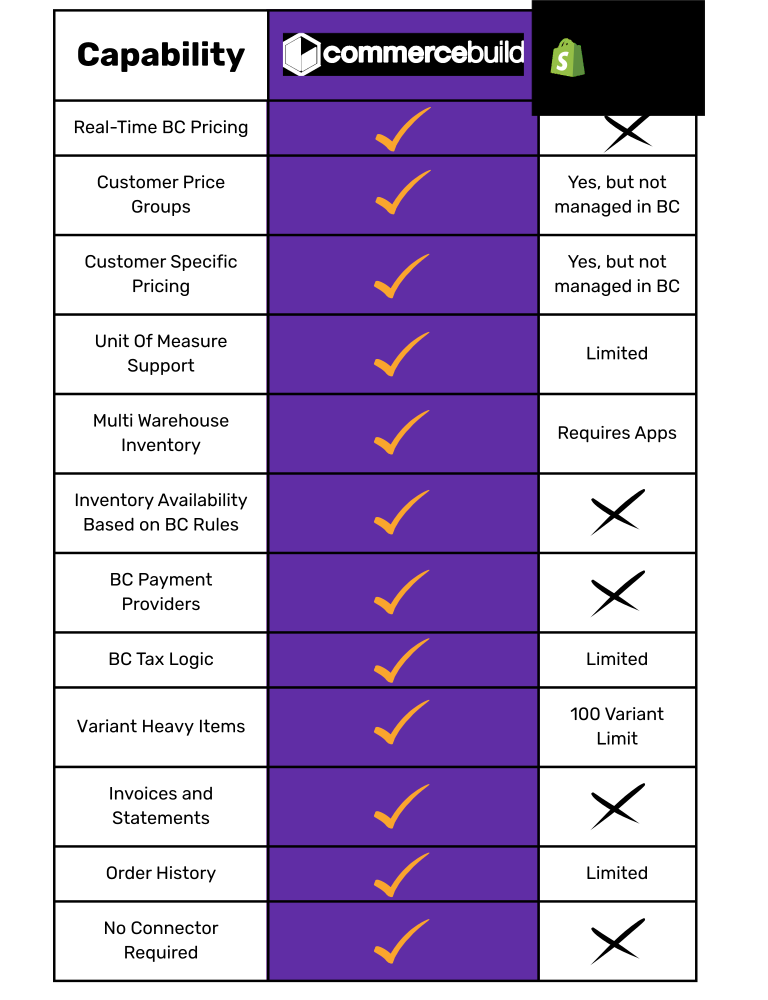
For companies that rely on ERP systems, the difference between commercebuild and Shopify is architectural, not cosmetic. commercebuild supports real-time ERP pricing, customer-specific pricing managed entirely in the ERP, full unit-of-measure functionality, multi-warehouse inventory, ERP-driven tax and payment logic, unlimited variant complexity, and customer access to invoices, statements, and order history.
Shopify, by contrast, requires ERP logic to be duplicated and maintained separately, imposes structural limits on products and variants, and relies heavily on apps and connectors to approximate ERP workflows. For ERP-driven businesses, these differences translate directly into accuracy, scalability, and long-term cost.
Where WooCommerce Fits When Powered by commercebuild
WooCommerce offers unmatched flexibility for design, content, SEO, and brand storytelling. On its own, however, it was not built to manage ERP-level logic. This is where commercebuild’s ERP-first engine transforms WooCommerce into a powerful solution for ERP-driven companies.
Using a headless architecture, commercebuild powers WooCommerce with real-time ERP pricing, inventory, customer-specific rules, units of measure, and order workflows. WooCommerce continues to manage the front-end experience, including themes, plugins, content, and checkout, while the ERP remains responsible for operational logic.
This clear separation of responsibilities creates a storefront that is both flexible and precise. WooCommerce stays fast and customizable, while ERP data remains accurate and authoritative.
Who ERP-First eCommerce Is For
ERP-first eCommerce is designed for businesses that operate in B2B, B2C, or hybrid environments and depend on accurate pricing, complex discount structures, large or variant-heavy catalogs, multiple units of measure, multi-warehouse or bin-level inventory, and customer account visibility. These businesses often operate in manufacturing, wholesale, or distribution and need their storefront to reflect ERP reality without exposing complexity to customers.
Shopify remains a good fit for simpler D2C businesses with small catalogs and minimal ERP dependency. For companies where ERP logic drives the business, however, ERP-first eCommerce is not a preference, it is a requirement.
The Bottom Line
When ERP accuracy matters, syncing data into a platform that was never designed for it will always introduce risk, cost, and operational friction. commercebuild removes that friction by making the ERP the foundation of the storefront rather than an external system to work around.
For Business Central and Sage ERP companies evaluating Shopify alternatives, or for businesses looking to power WooCommerce with true ERP logic, ERP-first eCommerce provides the clarity, accuracy, and scalability that modern operations demand.
See why ERP-driven companies choose commercebuild instead of Shopify.
Book your Business Central, Sage ERP, or ERP-First WooCommerce review, today.